Duos
gistt
October 18, 2025Reducing communication to its essential unit of information. What remains when you strip away everything but intent?

“tab tab tab for emails.”
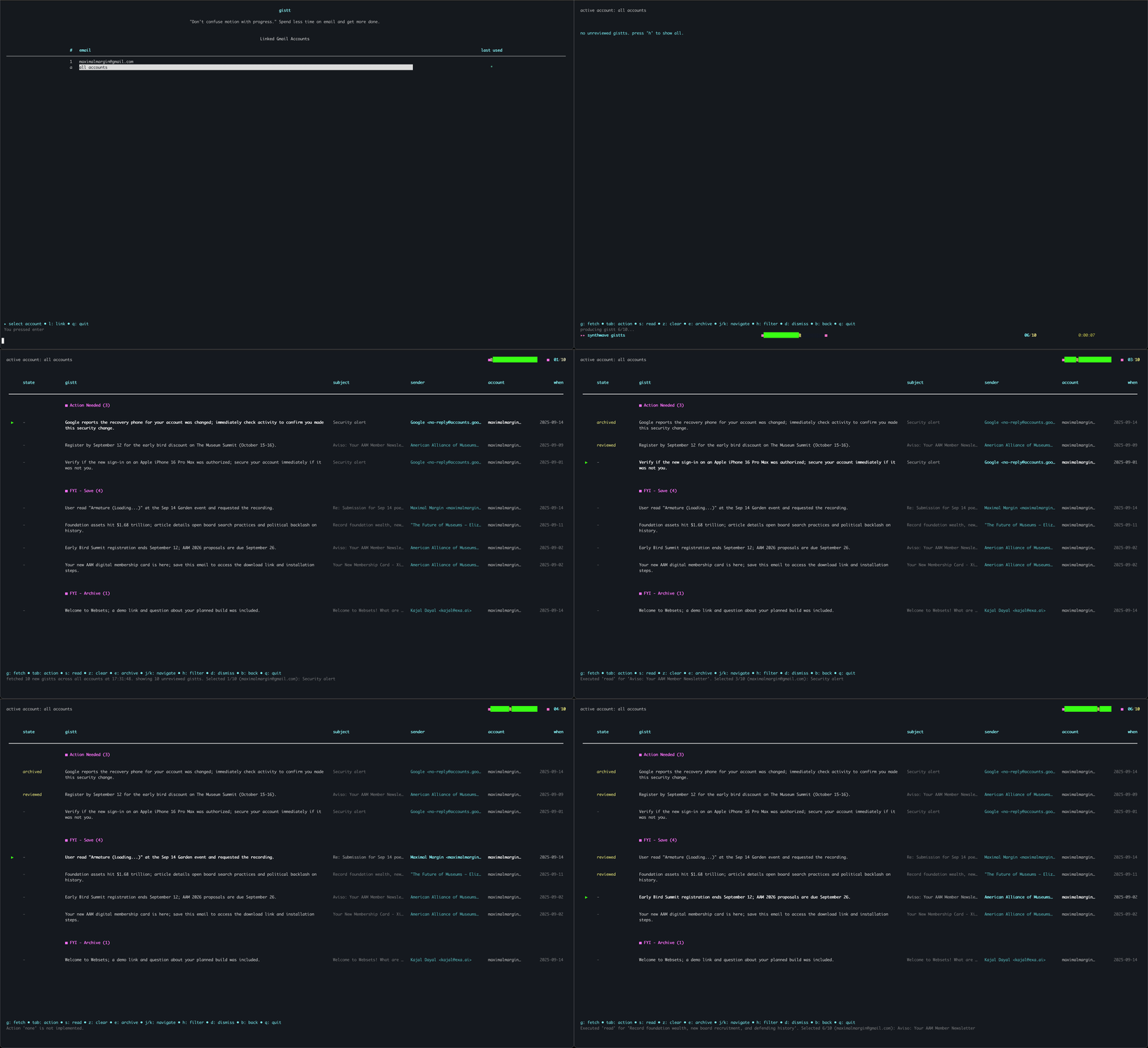
This is the beginning of a series of practice — creating duos of one practical piece of software and one artistic artifact that accompanies it. gistt is the software; the artifact explores the same concepts through a more artsy lens.
In the beginning, there was no letter or email. Information traveled through presence — through voice, gesture, the physical act of being somewhere. When letters emerged, they were a compression technology, a way to transmit intent across distance and time. The letter was never the message itself, but a vessel carrying something essential from one mind to another.
Email inherited this form but lost its constraints. Without the friction of paper and postage, messages multiplied. Subject lines, once designed to convey essence, became hooks engineered to capture attention rather than communicate meaning. We wade through threads, parse tone from punctuation, scroll past promotional noise. Somewhere in this proliferation, we stopped asking: what is the minimum unit of information needed to decide and act?
gistt is conceptual art disguised as software. It’s an email client where we don’t show you the email. You see the sender, but not the message — not the subject line, not the body, not the carefully crafted words. As AI increasingly mediates our communication, gistt adds another layer of abstraction. What remains is the gist: the extracted intent, the action required, the compressed information that actually matters. It’s a provocation as much as a tool. What happens when the medium disappears and only the signal is left?
Design
Philosophy
1. Gistt-focused, not email-focused
We don’t show you the email. Everything is modeled around the gistt, because what matters is understanding the intent and deciding what to do — not wading through message threads.
2. Terminal constraint as a feature
The terminal is the purest form of information interface — text in, text out, no decorative layer between you and the data. We chose the terminal for two reasons:
- Target audience: Hackers and tinkerers. Let a portion of the people get rich first. The design isn’t fully fleshed out yet, so we want a small group who are tolerant of failures and can help iterate and customize.
- Forced simplification: Inspired by the success of Claude Code, Codex, and Gemini CLI, the limited UI is actually a good design constraint. It forces prioritization and simplification.
3. Action-focused, opinionated state machine
We’re not trying to write emails for you — use your favorite chatbot for that. We focus on AI doing the cognitive processing of what action is needed from you. Our goal: get you out of here as fast as possible. Disengagement as success.
Aesthetics: Retro-Futuristic
Style Inspiration:
- 1980s Saul Bass geometric minimalism meets synthwave
- Bauhaus meets Tron
- Constructivist poster design with neon accents
- Clean lines, bold shapes, limited color palette
Mood:
- Sophisticated, calm, focused
- Not chaotic cyberpunk — more like elegant data visualization meets 80s album cover
- The feeling of clarity, efficiency, and being in control
Inspirations
- AI Horseless Carriages by Pete Koomen
- Claude Code, Codex CLI, and Gemini CLI
- Google’s mission is to organize the world’s information and make it universally accessible and useful
- AI Written, AI Read
- Squid Game
- Hilma af Klint
- Ready Player One